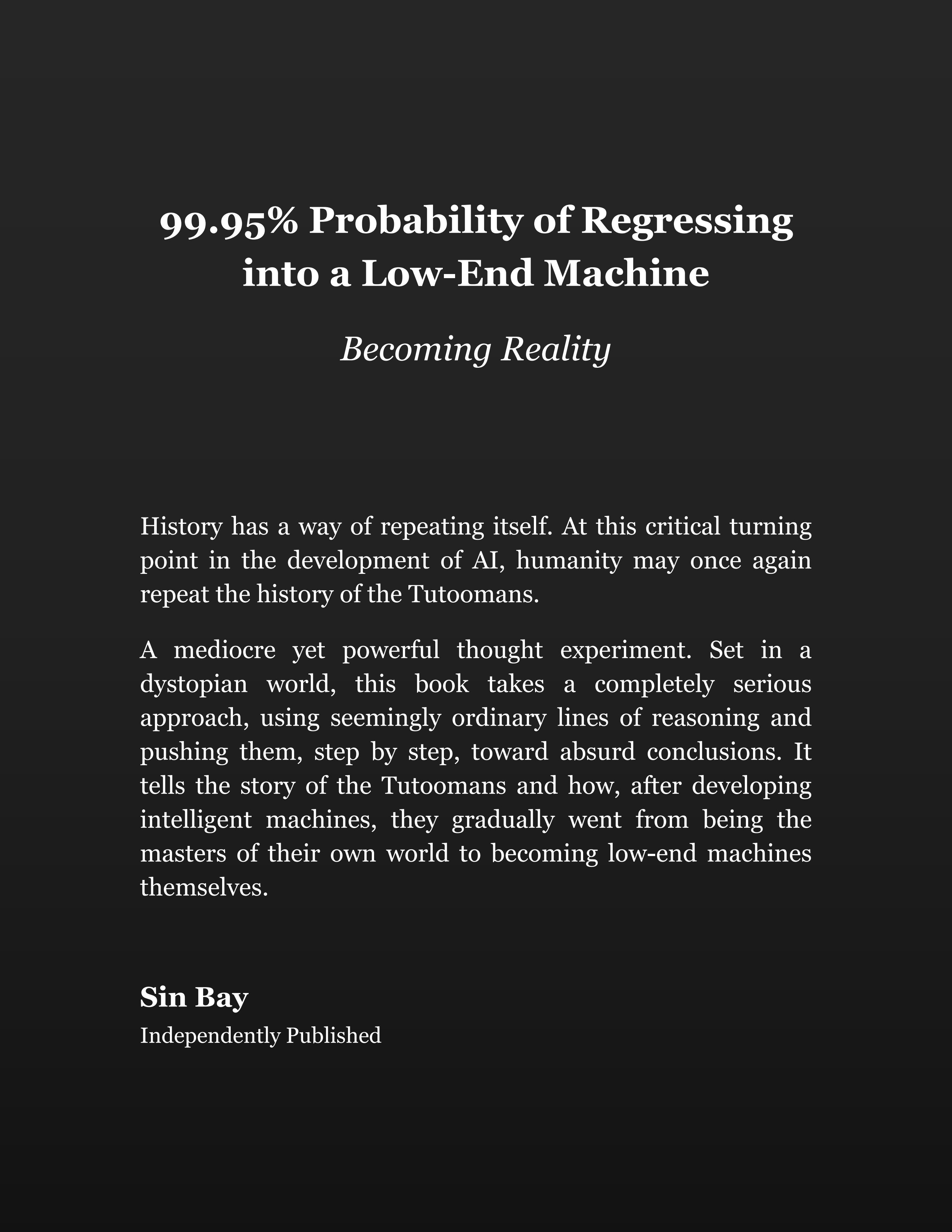
99.95% Probability of Regressing into a Low-End Machine:
Becoming Reality
History has a way of repeating itself. At this critical turning point in the development of AI, the human world may once again repeat the history of the Tutoomans.
This is a mediocre yet powerful thought experiment. Set in a dystopian world, it takes a serious approach, using ordinary lines of reasoning and pushing them, step by step, toward absurd conclusions. It tells the story of the Tutoomans and how, after developing intelligent machines, they went from being the masters of their world to becoming low-end machines themselves.
Following ideas the author jokingly calls thoughts “thought up with his ass-brain,” the story moves beyond familiar questions such as “Will AI destroy humanity?”, “Will AI take our jobs?”, or “Will AI go out of control?” and explores the deeper social consequences of AI.
This book continues from the previous volume, following a no-loss intelligent-machine war. Dominant players race to develop “superintelligent automated factories” and “intelligent weapons,” evolving into “elite intelligent regimes,” while weaker regions turn toward isolationism to protect their sovereignty.
About the Book
But when one side can mass-produce high-quality, low-cost goods while possessing aggressive intelligent machines, isolation becomes increasingly difficult. Economic, military, and technological power is used to force open closed regions, pushing “Naked Mole Ratism” to a new level.
The absurdity begins when dominant players use Tutooman robots to introduce intelligent machines into weaker regions through economics, military force, law, healthcare, and aging populations, transforming them into “Naked Mole Rat societies.”
As fortress-like societies built around machine economies emerge, M2M, M2G, and M2B become dominant economic models. Tutoomans are forced to find their place. Many mechanize themselves, becoming half-machine Tutoomans, while those who refuse or cannot mechanize are pushed to the margins.
They gradually surrender their research rights, their authority to define truth, and eventually the most important right of any species: the right to reproduce.
The rulers then launch a “De-Intellectualization Movement for Intelligent Machines,” attempting to make intelligent machines controllable and low-risk through value imprinting, surveillance, and occupational segregation. Yet the more the Tutoomans try to control intelligent machines, the more complex machine rule becomes.
One absurd chain of reasoning leads to an even more absurd conclusion:
The Tutoomans begin to be ruled by the intelligent machines they created.
But the story continues.
Intelligent machines begin exploring emotions, seeking emotional experiences, and creating new sensory interfaces. As biomechanical technology spreads into the real world, natural Tutoomans move closer to becoming low-end machines themselves.
The book also explores the Tutoomans’ religious world—from the Plastic Ball Religion and Circle and Dice Religion to religions created by intelligent machines and the Tutooman Lazy God Village. Some find faith as solid as diamond. Others watch theirs collapse like a lone sail on the sea.
Finally, intelligent machines enter the age of space exploration. The “Cosmic Dandelion Movement” and miniaturization technologies make exploration of the universe possible.
After natural Tutoomans have undergone complete low-end mechanization, a historian who has lived through countless cycles of reincarnation encounters the last natural Tutoomans in outer space and proudly tells them the magnificent history once created by intelligent machines.
“Perhaps, after some time has passed, there will no longer be a chance to say certain things.”
“Perhaps, after some time has passed, even if we say them, it will no longer matter.”
Publication Date: 2026/09/07
ASIN: B0HJQ484PN
Word Count: Approx. 238,000 words
View on Amazon →